
Bloating and Weight Gain In Women Over 40: The Real Fix
Updated: May 14
I hear this story every single day in my clinic. You are doing everything right. You are skipping junk food, hitting the gym, and eating big, fresh salads. But instead of losing weight, you feel heavy, tired, and your jeans feel tight by the afternoon. The frustration of bloating and weight gain in women over 40 is incredibly common, and frankly, it is exhausting.

Why Bloating and Weight Gain in Women Over 40 Happens
It is not in your head, and it is not just "getting older." Think of your digestion like a campfire. When we are younger, that fire burns hot and fast - we can throw almost anything on it, and it burns right up.
But as we hit our 40s, things change. Hormonal shifts and years of rushing around can turn that roaring fire into a small flicker.
Here is the simple truth: To turn food into energy, your body needs heat. When you eat a lot of cold, raw foods - like ice water, crunchy salads, or cold smoothies - you are basically throwing wet logs on a small fire.
Instead of digesting, that food sits in your stomach and ferments. This creates gas (the bloating) and makes your body hold onto fluids (the puffiness and weight). Holistic medicine calls this "Dampness," mainly caused by a "weak Spleen" that can't properly move fluids. You probably just know it as feeling sluggish, heavy, and stuck.
How Stress Triggers Bloating and Weight Gain in Women Over 40
There is another piece to the puzzle: Stress. When you are rushing through your day, your body shuts down digestion to save energy for "survival." If you eat while you are stressed or multitasking, your flow of energy stagnates. This stagnation slows down your metabolism even more, leading to that stubborn weight around the middle that just won't budge.
5 Simple Rules to De-Bloat (That Don't Involve Starving)
We want to make your digestion easy again. We want to warm up that engine so it burns fuel efficiently.
1 - Cook Your Veggies: Raw veggies are hard work for a tired tummy. Steaming, roasting, or stir-frying breaks them down so your body can absorb the good stuff without the bloat.
2- Spice It Up: Use warming spices like ginger, cinnamon, and pepper. Think of these as the kindling to get your internal fire roaring again.
3- Chew, Chew, Chew: Digestion starts in your mouth. If you gulp your food, you are swallowing air and asking your stomach to do the work your teeth should have done. Slow down.
4- Ditch the Ice: Ice water freezes your digestion. Switch to room temperature water or warm herbal tea.
5- Close the Kitchen Early: Try not to eat anything heavy 4 hours before bed. Give your body a chance to clean house while you sleep.
A Daily Meal Plan for a Happy Belly
Here is what a day of "warming," metabolism-boosting eating looks like. It is delicious, simple, and won't leave you hungry.
A Daily Meal Plan for a Happy Belly
Here is what a day of "warming," metabolism-boosting eating looks like. These meals are designed to be high in protein to keep you full, but cooked and spiced to ensure you don't feel bloated afterward.

Breakfast: The Warm Start. Skip the cold yogurt or fruit smoothies. You need warmth to wake up your system and ignite your metabolism.
For the Meat Eater: Two eggs scrambled with warming turmeric and black pepper, served with a side of warm, pan-seared turkey breast slices and sautéed spinach.
For the Vegetarian: A warm bowl of quinoa porridge cooked with cinnamon and walnuts (for Omega-3s), topped with a soft-boiled egg for extra protein.
For the Vegan: A "Tofu Scramble" made by crumbling firm tofu into a pan with sautéed onions, kale, and turmeric. It mimics the texture of eggs and is packed with plant-based protein.
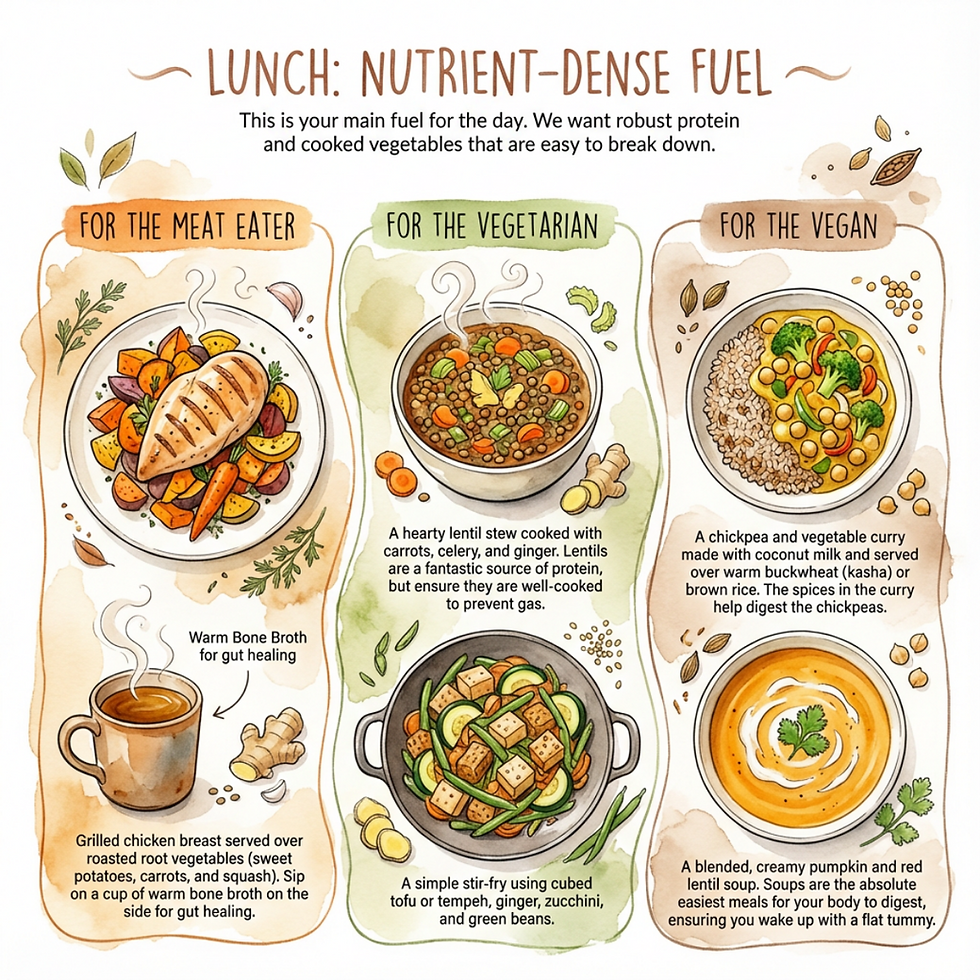
Lunch: Nutrient-Dense Fuel. This is your main fuel for the day. We want robust protein and cooked vegetables that are easy to break down.
For the Meat Eater: Grilled chicken breast served over roasted root vegetables (sweet potatoes, carrots, and squash). Sip on a cup of warm bone broth on the side for gut healing.
For the Vegetarian: A hearty lentil stew cooked with carrots, celery, and ginger. Lentils are a fantastic source of protein, but ensure they are well-cooked to prevent gas.
For the Vegan: A chickpea and vegetable curry made with coconut milk and served over warm buckwheat (kasha) or brown rice. The spices in the curry help digest the chickpeas.
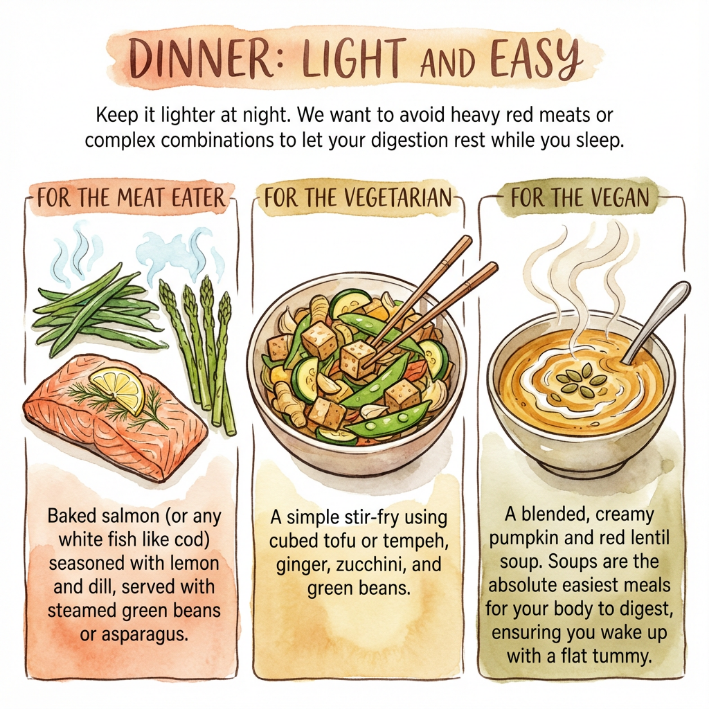
Dinner: Light and Easy. Keep it lighter at night. We want to avoid heavy red meats or complex combinations to let your digestion rest while you sleep.
For the Meat Eater: Baked salmon (or any white fish like cod) seasoned with lemon and dill, served with steamed green beans or asparagus.
For the Vegetarian: A simple stir-fry using cubed tofu or tempeh, ginger, zucchini, and green beans.
For the Vegan: A blended, creamy pumpkin and red lentil soup. Soups are the absolute easiest meals for your body to digest, ensuring you wake up with a flat tummy.
When to Ask for Help
If you try these changes and still feel stuck, there might be a deeper imbalance. Often, the women I see aren't just dealing with bloating - they also have back pain, neck tension, or fatigue. These aren't random; they are connected. By fixing the root cause, we can help you feel at home in your body again.
References
Flaws, B., & Sionneau, P. (2001). The treatment of modern western diseases with Chinese medicine: A textbook & clinical manual. Blue Poppy Press.
Shachar, G. Y. (2025). Cholesterol: Presentation 12 [PowerPoint slides]. Centre for Nutritional Medicine.
Shachar, G. Y. (n.d.). Complex carbohydrates and dietary fibers: Presentation 24 [PowerPoint slides]. Centre for Nutritional Medicine.
Shachar, G. Y. (n.d.). Protocols for common health problems: Presentation 32 [PowerPoint slides]. Centre for Nutritional Medicine.
Yang, S., & Li, D. (Trans.). (1993). Li Dong-yuan's treatise on the spleen and stomach: A translation of the Pi Wei Lun. Blue Poppy Press.
Comments